[et_pb_section bb_built=”1″ admin_label=”section” _builder_version=”3.0.47″][et_pb_row _builder_version=”3.0.47″ background_size=”initial” background_position=”top_left” background_repeat=”repeat”][et_pb_column type=”4_4″][et_pb_text admin_label=”Paragraph 1″ _builder_version=”3.0.47″ text_font_size=”16″ text_line_height=”1.9em” background_size=”initial” background_position=”top_left” background_repeat=”repeat” text_orientation=”justified” custom_margin=”-25px|||” custom_padding=”||10px|” use_border_color=”off” border_color=”#ffffff” border_style=”solid”]
As life science researchers, we all understand the importance of obtaining reliable, consistent binding kinetics for biomolecular interactions. Researchers also know that using SPR to measure these kinetics is the gold-standard technique. However, many researchers face a huge barrier when considering SPR for their projects – SPR has traditionally required a huge learning curve, and often a designated technician! At Nicoya, we have made this crucial technique more accessible, providing researchers with OpenSPR, an instrument so easy to use that a 17-year-old summer student mastered it.
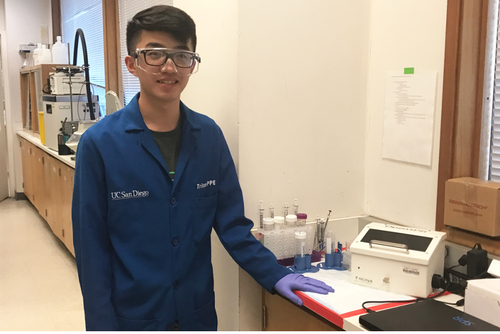
Eric had the chance to dive into his passion in science this summer by getting a head start on his career in glycoscience research. Eric became an SPR expert over the course of his summer mentorship under Ember Tota, a graduate student at the University of California San Diego (UCSD). In our most recent interview, Ember discusses how she and Eric used OpenSPR to look at glycan interactions in neuromuscular junction formation.
[/et_pb_text][/et_pb_column][/et_pb_row][et_pb_row _builder_version=”3.0.47″ background_size=”initial” background_position=”top_left” background_repeat=”repeat”][et_pb_column type=”4_4″][et_pb_text admin_label=”Quote” _builder_version=”3.0.96″ text_font_size=”16″ text_line_height=”1.9em” background_size=”initial” background_position=”top_left” background_repeat=”repeat” custom_margin=”-20px|||” use_border_color=”off” border_color=”#ffffff” border_style=”solid”]
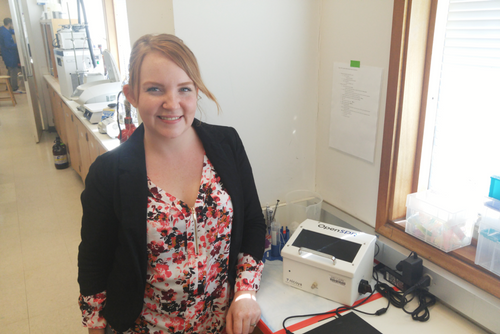
USCD graduate student Ember Tota next to Nicoya’s benchtop OpenSPR (previous model).
[/et_pb_text][/et_pb_column][/et_pb_row][et_pb_row _builder_version=”3.0.47″ background_size=”initial” background_position=”top_left” background_repeat=”repeat”][et_pb_column type=”4_4″][et_pb_text admin_label=”Paragraph 3″ _builder_version=”3.0.47″ text_font_size=”16″ text_line_height=”1.9em” background_size=”initial” background_position=”top_left” background_repeat=”repeat” custom_margin=”-20px|||” use_border_color=”off” border_color=”#ffffff” border_style=”solid”]
[/et_pb_text][/et_pb_column][/et_pb_row][et_pb_row padding_mobile=”off” column_padding_mobile=”on” parallax_method_1=”off” _builder_version=”3.0.47″ background_size=”initial” background_position=”top_left” background_repeat=”repeat”][et_pb_column type=”4_4″][et_pb_text admin_label=”Quote” _builder_version=”3.0.47″ text_font_size=”16″ text_line_height=”1.9em” background_size=”initial” background_position=”top_left” background_repeat=”repeat” custom_margin=”-20px|||” use_border_color=”off” border_color=”#ffffff” border_style=”solid”]
Tell us about the exciting work you do.
[/et_pb_text][/et_pb_column][/et_pb_row][et_pb_row _builder_version=”3.0.47″ background_size=”initial” background_position=”top_left” background_repeat=”repeat”][et_pb_column type=”4_4″][et_pb_text admin_label=”Paragraph 3″ _builder_version=”3.0.47″ text_font_size=”16″ text_line_height=”1.9em” background_size=”initial” background_position=”top_left” background_repeat=”repeat” custom_margin=”-20px|||” use_border_color=”off” border_color=”#ffffff” border_style=”solid”]
I look at the importance of glycan interactions in cellular function. Specifically, I am looking at the importance of glycans in neuromuscular junction formation. We employ our fully characterized glycan mimetics into cellular systems and interrogate their role and effects on the system.
Glycans cover the surfaces of cells and they often act as important receptors for different growth factors involved in cell signaling, differentiation, communication, and many other important functions. It is important for us to characterize the interactions between our mimetics and these growth factors of interest.
[/et_pb_text][/et_pb_column][/et_pb_row][et_pb_row _builder_version=”3.0.47″ background_size=”initial” background_position=”top_left” background_repeat=”repeat”][et_pb_column type=”4_4″][et_pb_text admin_label=”Paragraph 2″ _builder_version=”3.0.47″ text_font_size=”16″ text_line_height=”1.9em” background_size=”initial” background_position=”top_left” background_repeat=”repeat” custom_margin=”-20px|||” use_border_color=”off” border_color=”#ffffff” border_style=”solid”]
How has OpenSPR been the key to getting your results?
[/et_pb_text][/et_pb_column][/et_pb_row][et_pb_row _builder_version=”3.0.47″ background_size=”initial” background_position=”top_left” background_repeat=”repeat”][et_pb_column type=”4_4″][et_pb_text admin_label=”Paragraph 3″ _builder_version=”3.0.47″ text_font_size=”16″ text_line_height=”1.9em” background_size=”initial” background_position=”top_left” background_repeat=”repeat” custom_margin=”-20px|||” use_border_color=”off” border_color=”#ffffff” border_style=”solid”]
OpenSPR has given us a reliable, cost effective way to obtain kinetic data pertaining to these interactions. With the sensitivity of OpenSPR, we have been able to more easily detect weaker interactions. This instrument will continue to help us better characterize our materials and understand their interactions with biological molecules of interest.
[/et_pb_text][/et_pb_column][/et_pb_row][et_pb_row _builder_version=”3.0.47″ background_size=”initial” background_position=”top_left” background_repeat=”repeat”][et_pb_column type=”4_4″][et_pb_text admin_label=”Paragraph 2″ _builder_version=”3.0.47″ text_font_size=”16″ text_line_height=”1.9em” background_size=”initial” background_position=”top_left” background_repeat=”repeat” custom_margin=”-20px|||” use_border_color=”off” border_color=”#ffffff” border_style=”solid”]
With no prior knowledge or experience using SPR, how helpful was the OpenSPR training process?
[/et_pb_text][/et_pb_column][/et_pb_row][et_pb_row _builder_version=”3.0.47″ background_size=”initial” background_position=”top_left” background_repeat=”repeat”][et_pb_column type=”4_4″][et_pb_text admin_label=”Paragraph 3″ _builder_version=”3.0.47″ text_font_size=”16″ text_line_height=”1.9em” background_size=”initial” background_position=”top_left” background_repeat=”repeat” custom_margin=”-20px|||” use_border_color=”off” border_color=”#ffffff” border_style=”solid”]
To begin using the instrument, I read the instruction manual which was very helpful. I then used a process of trial and error with different conditions to obtain a set of conditions that worked well for my system.
[/et_pb_text][/et_pb_column][/et_pb_row][et_pb_row _builder_version=”3.0.47″ background_size=”initial” background_position=”top_left” background_repeat=”repeat”][et_pb_column type=”4_4″][et_pb_text admin_label=”Quote” _builder_version=”3.0.47″ text_font_size=”16″ text_line_height=”1.9em” background_size=”initial” background_position=”top_left” background_repeat=”repeat” custom_margin=”-20px|||” use_border_color=”off” border_color=”#ffffff” border_style=”solid”]
“The team at Nicoya has been very helpful, promptly answering any questions, helping me analyze data, troubleshooting issues, and helping me learn the ins and outs of how the instruments works. The initial training was very fast and simple; the longest portion has been optimization for my own system.” – Ember Tota
[/et_pb_text][/et_pb_column][/et_pb_row][et_pb_row _builder_version=”3.0.47″ background_size=”initial” background_position=”top_left” background_repeat=”repeat”][et_pb_column type=”4_4″][et_pb_text admin_label=”Paragraph 2″ _builder_version=”3.0.47″ text_font_size=”16″ text_line_height=”1.9em” background_size=”initial” background_position=”top_left” background_repeat=”repeat” custom_margin=”-20px|||” use_border_color=”off” border_color=”#ffffff” border_style=”solid”]
How did you use OpenSPR to help 17-year-old Eric Wang become an SPR expert within 2 months?
[/et_pb_text][/et_pb_column][/et_pb_row][et_pb_row admin_label=”row” _builder_version=”3.0.47″ background_size=”initial” background_position=”top_left” background_repeat=”repeat”][et_pb_column type=”4_4″][et_pb_text admin_label=”Paragraph 3″ _builder_version=”3.0.47″ text_font_size=”16″ text_line_height=”1.9em” background_size=”initial” background_position=”top_left” background_repeat=”repeat” custom_margin=”-20px|||” use_border_color=”off” border_color=”#ffffff” border_style=”solid”]
I mentored a high school student, Eric Wang, over the summer who quickly and easily picked up on how to use the instrument. This was possible because of the simplicity of the instrument, with few “moving parts” it is easy to troubleshoot/repair/replace things when there is a problem.
[/et_pb_text][/et_pb_column][/et_pb_row][et_pb_row admin_label=”row” _builder_version=”3.0.47″ background_size=”initial” background_position=”top_left” background_repeat=”repeat”][et_pb_column type=”4_4″][et_pb_text admin_label=”Paragraph 4″ _builder_version=”3.0.47″ text_font_size=”16″ text_line_height=”1.9em” header_text_color=”#000000″ background_size=”initial” background_position=”top_left” background_repeat=”repeat” custom_margin=”-20px|||” use_border_color=”off” border_color=”#ffffff” border_style=”solid”]
OpenSPR is a user-friendly and low maintenance solution to get the binding kinetics data you need. If 17-year-old Eric can master SPR, so can you.
[/et_pb_text][/et_pb_column][/et_pb_row][et_pb_row admin_label=”row” padding_mobile=”off” column_padding_mobile=”on” parallax_method_1=”off” _builder_version=”3.0.47″ background_size=”initial” background_position=”top_left” background_repeat=”repeat”][et_pb_column type=”4_4″][et_pb_cta button_url=”https://hubs.ly/H0fn0gz0″ url_new_window=”on” button_text=”Discuss your interactions with an application scientist today” use_background_color=”off” background_layout=”light” _builder_version=”3.0.96″ header_text_color=”#1e73be” body_font_size=”16″ background_size=”initial” background_position=”top_left” background_repeat=”repeat” use_border_color=”off” custom_button=”off” button_icon_placement=”right”]