At Nicoya, we believe some of the most important biological insights are hidden in motion.
Proteins are dynamic — constantly shifting, interacting, and changing shape across timescales that traditional analytical tools often struggle to capture. For years, researchers using hydrogen-deuterium exchange mass spectrometry (HDX-MS) have pushed the field forward with incredible innovation, but broadly accessible millisecond-resolved HDX-MS has remained largely out of reach for many laboratories.
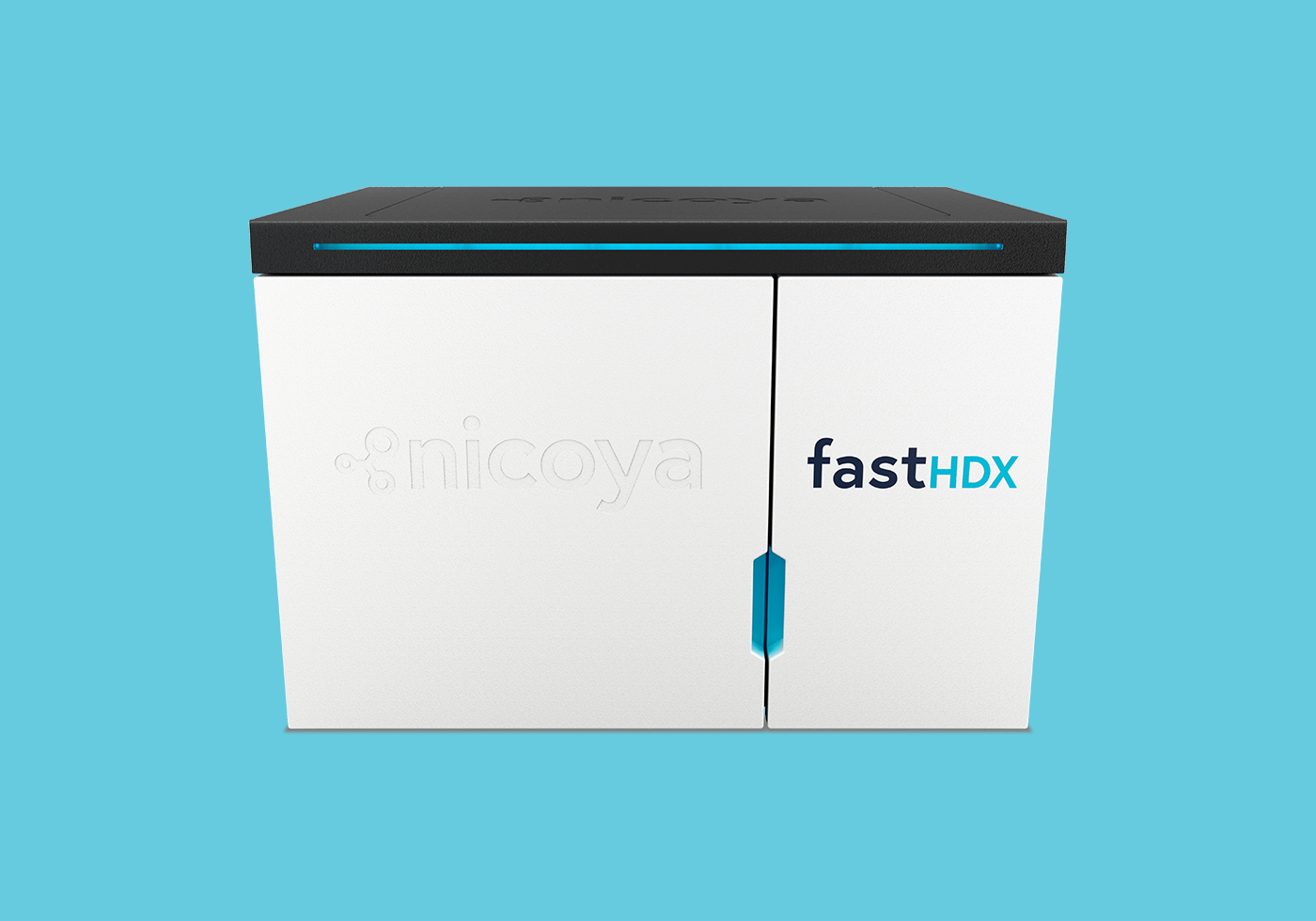
That’s why we’re excited to announce a new collaboration with researchers at the Broad Institute focused on expanding access to next-generation HDX-MS capabilities through FastHDX™.
The collaboration with Dr. Malvina Papanastasiou, Senior Group Leader within the Proteomics Platform led by Senior Director Dr. Steven Carr and R&D Director Dr. Namrata Udeshi at the Broad Institute, will support the integration and application of FastHDX for studying protein dynamics, conformational changes, molecular interactions, and mechanisms relevant to drug discovery and structural biology.
FastHDX was developed to help researchers observe biological events that occur at extremely fast timescales — from transient conformational changes to weak or rapidly evolving interactions that may be missed using conventional HDX-MS workflows.
By enabling labeling times from 50 milliseconds to 24+ hours with 1 millisecond resolution, FastHDX opens new opportunities to study dynamic biological systems with greater temporal precision and accessibility.
“FastHDX was built to help researchers explore biology at timescales that have traditionally been difficult to access,” said Ryan Denomme, CEO of Nicoya. “We’re excited to collaborate with the Broad Institute and support the incredible work Dr. Papanastasiou and the proteomics team are doing to advance our understanding of protein dynamics and molecular mechanisms. Having leading researchers like Dr. Papanastasiou evaluate the platform and provide feedback is also incredibly valuable as we continue innovating and developing the next generation of HDX-MS technologies.”
For us, this collaboration represents more than the adoption of a new technology platform. It reflects a broader shift happening across the field: growing recognition that understanding protein motion and structural dynamics is becoming increasingly important for advancing drug discovery and mechanistic biology.
The Broad Institute has long been recognized as a leader in applying advanced technologies to complex biological questions, and we’re excited to support researchers exploring how millisecond-resolved HDX-MS can expand the boundaries of structural proteomics research.
Since introducing FastHDX earlier this year, we’ve seen remarkable enthusiasm from both academic and pharmaceutical researchers interested in bringing millisecond-resolved HDX-MS into their workflows. We believe this is only the beginning.
As the field continues to evolve, we’re committed to making advanced protein dynamics tools more accessible, more practical, and more impactful for the scientists pushing discovery forward.
We look forward to sharing more updates from this collaboration in the future.
ASMS 2026
Dr. Papanastasiou and members of her team, as well as Nicoya, will be attending the American Society for Mass Spectrometry Conference 2026 in San Diego this year. Some exciting presentations to note:
User Meeting
Thermo Fisher Sunday User Meeting – Malvina Papanastasiou
A novel, high-throughput, nHDX-MS platform for epitope and paratope mapping at scale
Manchester Grand Hyatt (Ballroom G): Integrative Structural Biology
Poster Session
TP009: Accelerating development and characterization of nanobodies using the integrated high-throughput Rapid Automated Binder Identification Technology (RABIT) and ultrasensitive nHDXMS; Shaunak Raval1; Daniel Rosen1; Jaechan Lee1; Nir Hacohen1; Steven A. Carr1; Malvina Papanastasiou1; 1The Broad Institute of MIT and Harvard, Cambridge, MA
ThP 521: Ultrasensitive nHDX-MS for high-throughput analysis of challenging protein-ligand and protein-protein interactions; Shaunak Raval1 ; Yuqi Shi2 ; Daniel Rosen1 ; Jaechan Lee1 ; Siddhant U. Jain3, 4; Cigall Kadoch3, 4; Nir Hacohen1 ; Steven A. Carr1 ; Malvina Papanastasiou1 ; 1Broad Institute, Cambridge, MA; 2Thermo Fisher Scientific, San Jose, CA; 3Dana-Farber Cancer Institute, Boston, MA; 4Harvard Medical School, Boston, MA