Learn how Radix BioSolutions®, a CRO based in Georgetown, Texas, has expanded its service offerings through the use of Nicoya’s Alto™ platform.
Like many global CROs, Radix BioSolutions has been considering SPR for a long time. Unfortunately, many purchasing factors have pushed them away from traditional SPR instruments, including high cost, maintenance requirements, and complexity. And then they found Nicoya and the Alto, the world’s first fully automatable SPR system. We recently sat down with President, CSO, and co-founder of Radix BioSolutions, Dr. Kerry Oliver, to learn more about their decision to purchase an Alto system and how it has helped their company grow.
1. Dr. Oliver, can you tell us a bit about Radix BioSolutions? What types of services does your organization provide?
Radix BioSolutions is a full-spectrum immunoassay and biomarker development Contract Research Organization. We support every phase of the immunoassay lifecycle:
- Critical reagent conjugation and modification
- Custom assay development (ELISA, Luminex®, MSD®, and SMCxPRo®)
- Sample testing across multiple species and matrices
How does SPR fit into these services?
SPR complements our traditional immunoassay services by offering a label-free, real-time platform to evaluate binding kinetics, epitope binning, and antibody screening. It has become an essential orthogonal tool for validating assay reagents and understanding molecular interactions in early assay development.
2. Did you or your team have any experience with SPR before using Alto?
Our team was familiar with both SPR and BLI technologies, and we have periodically evaluated acquiring a system over the past decade. However, our analyses consistently showed that the cost–benefit balance did not justify the investment. Alto, by contrast, provides a far more accessible, cost-effective, and user-friendly platform, which has lowered the barrier for integrating label-free technology into our routine development workflows
3. Can you describe a project where you used Alto?
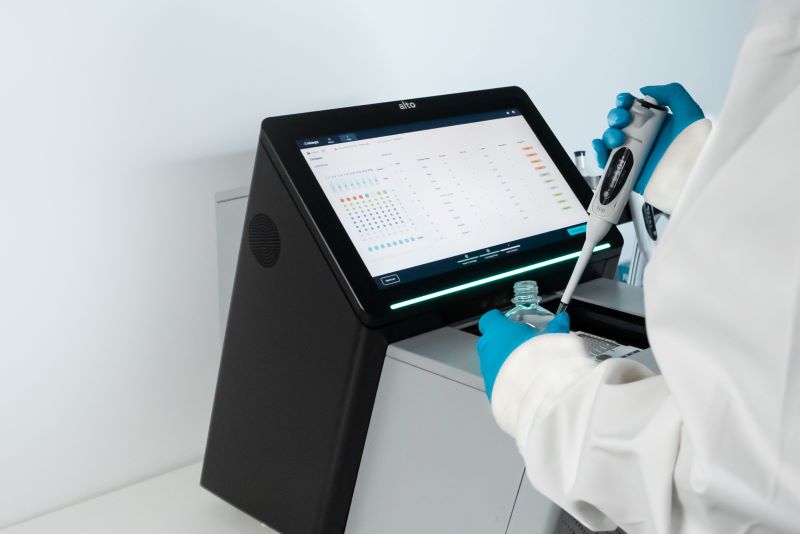
We recently used Alto in a multi-phase antibody screening and assay development project to detect a disease-specific biomarker.
- Types of molecules studied: Monoclonal antibodies and peptides.
- Types of assays run: Affinity screening, binding kinetics, and epitope binning to support sandwich immunoassay design.
- Orthogonal techniques used: ELISA, MSD-ECL, Luminex, and SMCxPRO for parallel analysis and assay development.
- Research goals: To develop a high-throughput, robust capture-detection antibody pair for a novel high-sensitivity biomarker assay.
- Results and broader impact: Alto accelerated our epitope binning process. The optimal pair results were corroborated by Luminex technology. This data illustrated that the Alto binning analysis could be integrated as a walk-away tool for selecting optimal antibody pairs for capture-sandwich immunoassay development.
4. What are the key benefits you’ve experienced with Alto, and how have these helped your business?
- Improved reagent quality control:
- We use Alto to verify covalent conjugation outcomes and binding integrity.
- Faster assay optimization:
- Kinetics and binning analysis data improve matched pair selection, assay robustness, and assay sensitivity.
- Operational efficiency:
- The walk-away automation and low maintenance requirements reduce downtime and increase throughput.
- Strategic value:
- Alto has opened new service offerings for critical reagent conjugation and for the introduction of label-free, single antibody immunoassays.
5. Would you recommend Alto to other organizations?
Yes, especially for CROs or diagnostic labs that need affordable, flexible SPR without the infrastructure and cost burden of traditional systems. Alto does this without the need for a dedicated, SPR-experienced user, and the ease of use ensures that the entire lab can be users.
6. What advice would you give to someone considering Alto for their lab?
- Start with a defined project (e.g., binning or kinetic screening) to quickly realize value.
- Train a small core team first – Alto is intuitive but still benefits from focused onboarding.
- Use it as a complement, not a replacement, for your existing platforms.
- It thrives when paired with orthogonal immunoassay technologies, especially Luminex, for validation.
8. What made you choose Alto over other label-free instruments?
The Alto system meets all the essential requirements of a label-free binding analysis platform, delivering reliable kinetics, affinity data, and ease of use. But Alto doesn’t stop at checking boxes. Unlike traditional SPR or BLI instruments that jockey for position in a crowded marketplace, Alto redefines the entire market by reshaping what’s possible in accessible, scalable, label-free analysis by its –
- Favorable cost-to-capability ratio
- Walk-away automation with easy-to-use software
- Essentially zero maintenance
- Ability to operate in standard lab environments without dedicated SPR technicians
- Strong alignment with labs performing antibody screening for assay development and testing changes in binding affinity following critical reagent conjugations.
9. How was your experience getting started with Alto?
It was a very quick deployment, and we were up and running within days of delivery. The intuitive UI and guided protocols made training efficient, and the array of ready-to-use reagents for optimizing binding analysis greatly speeds binding analysis optimization. Additionally, our team has felt comfortable enough with the system and their training to continue training new employees.
10. Is there anything else you would like to make potential customers aware of regarding Alto?
The pre-packaged consumables are a game-changer. They are invaluable for both discovery and routine work. For discovery work, not having to weigh out and produce new buffers at different pHs every time you are doing a discovery assay saves insurmountable time and effort. Being able to test multiple conditions does a great job at optimizing treatments, binding conditions, and regeneration conditions. These are things that, without the presence of pre-packaged reagents, wouldn’t get done.