In July 2025, Nicoya joined forces with Labman Automation, CPI, and Basetwo AI to launch the BALANCE project, an international initiative aimed at making biopharmaceutical manufacturing smarter, faster, and more efficient.
The vision was to develop an AI-powered bioreactor platform that could combine real-time analytical measurements, automated sampling, and predictive process control to improve biologics production.
Supported by a $2 million grant through the Canada–UK Collaborative R&D initiative, the 20-month project brought together complementary technologies and expertise to address a longstanding challenge in bioprocess development: how to obtain timely process information and use it to make better decisions with less manual intervention.
Just over a year later, that vision has progressed from concept to working demonstration.
In November 2026, project partners Basetwo AI and Labman announced significant milestones in the BALANCE collaboration, including successful autonomous bioreactor control and the integration of Nicoya’s Alto Digital SPR platform for automated antibody quantitation.
Together, these achievements mark important progress toward more connected, data-driven biomanufacturing.
Delivering on the BALANCE Vision: What’s Been Achieved?
The BALANCE project, short for Bioreactor Automation for Learning and Adaptive Networked Control of Experiments, was designed to bring together four complementary capabilities: advanced biosensing, robotic automation, bioprocess expertise, and AI-driven process control.
The latest demonstrations show how these technologies can work together in a bioprocessing environment.
Using fed-batch bioreactors producing a trastuzumab biosimilar candidate, a therapeutic antibody targeting HER2, the collaborators demonstrated:
- Autonomous bioreactor control: Basetwo’s AI platform predicted glucose demand and automatically adjusted nutrient feeding to maintain glucose levels within a target range.
- Improved process performance: AI-controlled runs achieved higher cell viability and antibody titer compared with the manual-control condition.
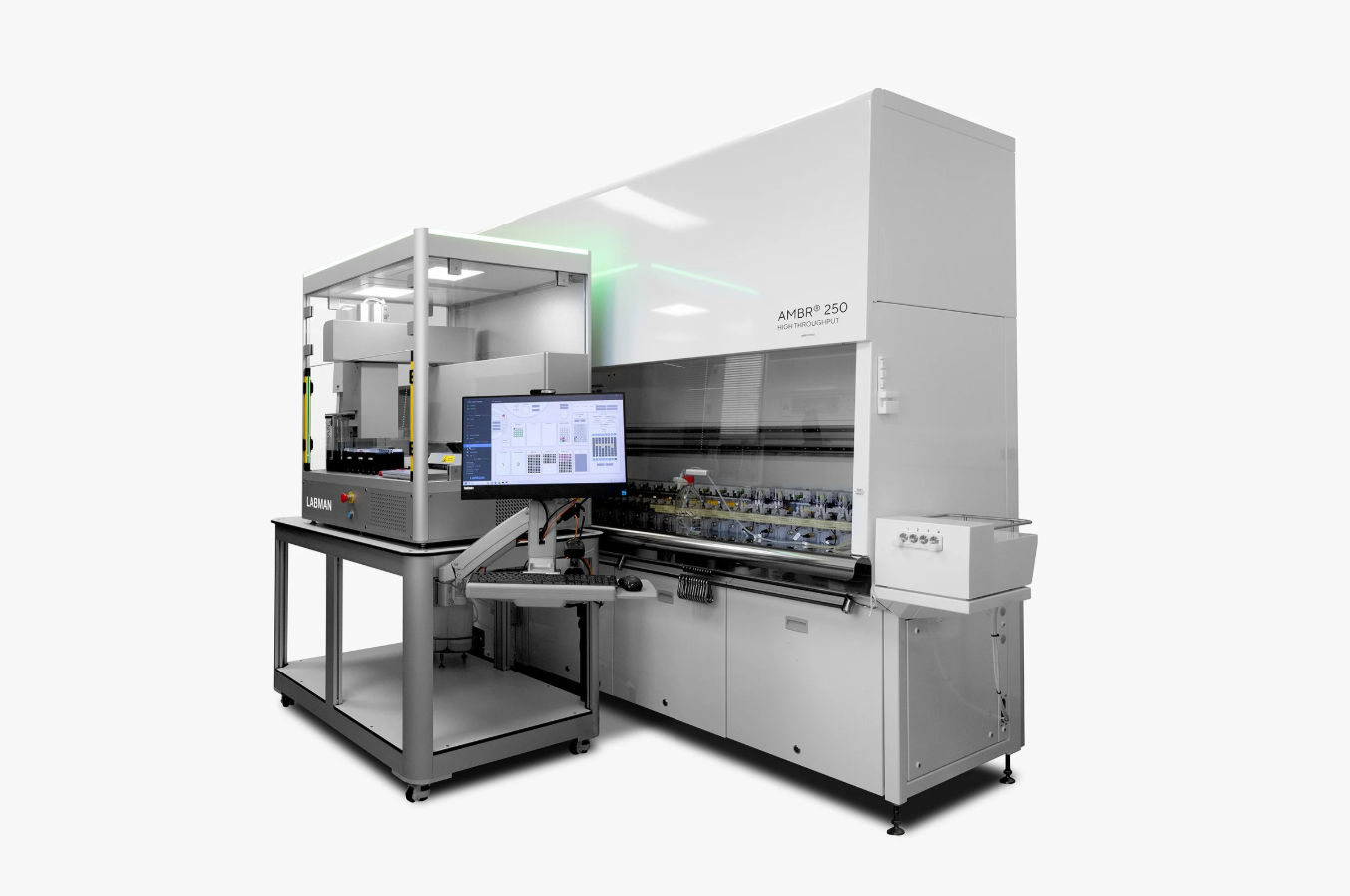
- Automated sample handling: Labman’s robotic platform collected, prepared, and transferred bioreactor samples for analysis without manual intervention during the automated workflow.
- Integrated antibody quantitation: Nicoya’s Alto Digital SPR platform measured antibody titer directly from crude culture supernatant during the bioreactor run.
- Demonstration across bioreactor scales: The integrated approach was evaluated using 0.2 L and 10 L bioreactor systems at CPI.
These results demonstrate meaningful progress toward the project’s original goal of making bioprocess development more responsive, efficient, and automated.
Nicoya’s Contribution: Bringing Digital SPR into the Bioreactor Workflow

For Nicoya, one of the most significant milestones was the successful integration of the Alto Digital SPR platform into Labman’s automated sampling workflow.
In traditional bioprocess development, measuring antibody production often requires samples to be collected, prepared, and analyzed through separate laboratory workflows. This can create delays between when a sample is taken and when scientists receive the results.
The BALANCE project demonstrates a more integrated approach.
Labman’s robotic system automatically collects samples from the bioreactor, prepares them, and delivers them to Alto through its automation interface. Alto then runs calibration standards and quantifies antibody titer directly from crude culture supernatant.
The result is a fully automated sample-to-answer workflow that provides antibody titer measurements while the bioreactor run is still underway.
This demonstration highlights several capabilities of the Alto Digital SPR that make it well suited for automated bioprocess analytics:
- Label-free antibody quantitation without additional molecular labeling steps.
- Crude-sample compatibility, enabling direct analysis of culture supernatant.
- Automation-ready integration through Alto’s software interface.
- Unattended, repeatable measurements that reduce reliance on manual analytical workflows.
Importantly, the successful integration demonstrates that Digital SPR can extend beyond standalone laboratory analysis and become part of larger automated bioprocessing systems.
Connecting Analytical Insights with Intelligent Process Control
One of the central goals of BALANCE is to bring analytical measurements closer to the decisions that influence biologics production.
Bioreactor sensors provide valuable information about operating conditions, including pH, dissolved oxygen, temperature, and nutrient levels. However, these measurements do not necessarily tell scientists how much therapeutic protein is being produced.
Alto adds a complementary analytical capability by measuring antibody titer directly from bioreactor samples.
In the latest demonstration, Basetwo’s AI system used process data to autonomously manage glucose feeding, while Alto provided independent, in-process antibody titer measurements.
Although Alto’s measurements were not used as direct inputs to the AI controller in this demonstration, the successful integration establishes an important foundation for future workflows that could incorporate molecular-level information into automated process decisions.
Together, autonomous process control and integrated antibody quantitation bring the BALANCE project closer to its broader vision of intelligent, connected bioprocessing.
Making Automated Bioprocessing a Reality
Integrating analytical instruments into automated workflows involves more than simply connecting hardware.
Robotic sampling systems must reliably prepare and deliver samples, analytical instruments must execute methods consistently, and results must be accessible without requiring continuous operator involvement.
The close collaboration between Nicoya and Labman helped address these integration challenges, demonstrating how Digital SPR can operate as part of a coordinated, unattended analytical workflow.
Jamie McQuay, VP of Engineering at Nicoya, commented:
“What we’ve demonstrated through BALANCE is that Digital SPR doesn’t have to be a standalone analytical step. By integrating Alto into an automated bioreactor workflow, we’ve shown that it’s possible to collect a crude sample, quantify antibody titer, and make that information available while the process is still running, without manual intervention. It’s an important step toward bringing molecular measurements directly into the bioprocessing environment.”
Looking Ahead: The Next Step in Connected Biomanufacturing
When BALANCE was announced in 2025, the goal was to demonstrate how AI, automation, and advanced biosensing could work together to transform bioprocess development.
The latest results show meaningful progress toward that vision.
Autonomous glucose control has been demonstrated. Robotic sampling and sample preparation have been integrated. And Nicoya’s Alto Digital SPR has successfully delivered automated antibody titer measurements from crude bioreactor samples.
While additional development will be needed to fully connect molecular measurements with AI-driven control decisions, the collaboration has demonstrated several of the essential capabilities required to make that possible.
For Nicoya, these results reinforce the potential of Digital SPR as an enabling technology for automated bioprocess analytics, helping scientists obtain meaningful molecular information with less manual intervention.
As biomanufacturing continues to evolve, bringing together analytical technologies, automation, and intelligent process control will be essential to creating more efficient and adaptable workflows.
BALANCE is demonstrating how that future can become a reality.
Follow the BALANCE Project
Explore the original project announcement and the latest milestones from our collaboration partners: